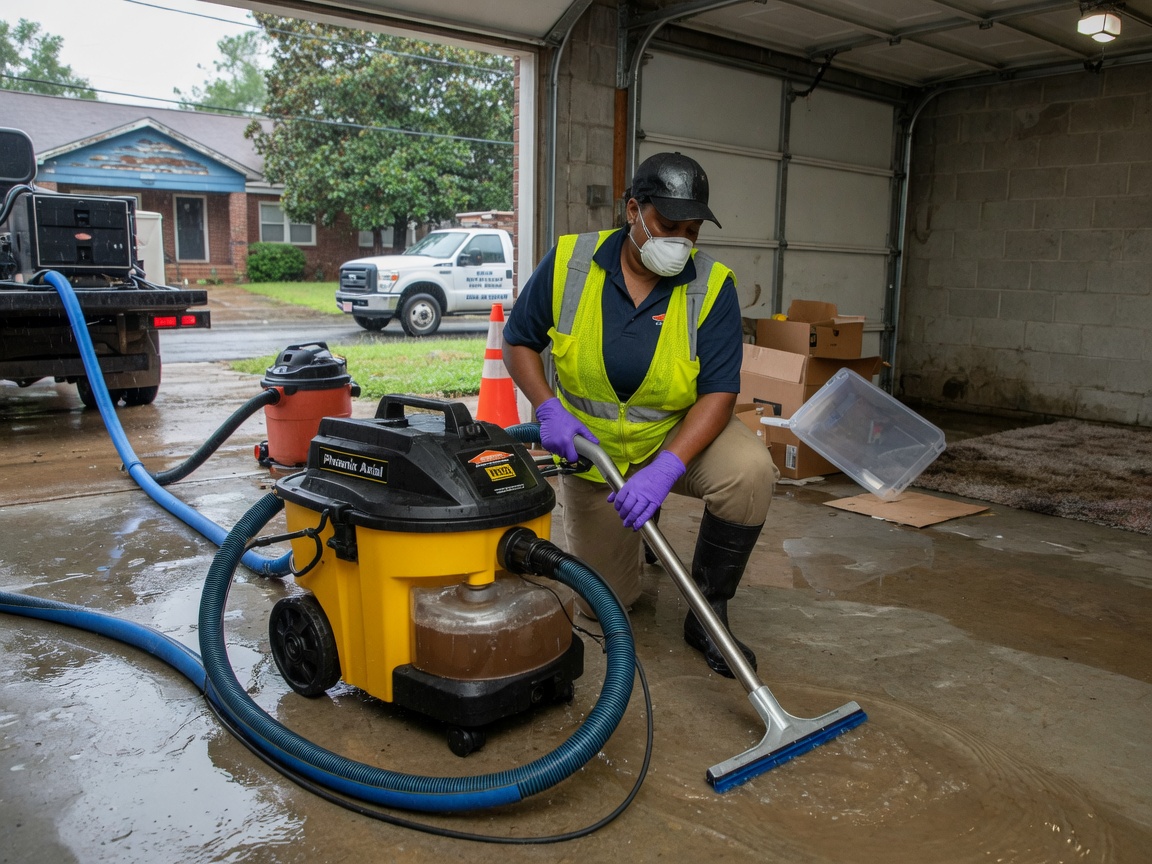
Decatur sits in Morgan County along the Tennessee River with a humid subtropical climate that brings heavy summer storms and lingering moisture. Older housing stock in Old Decatur and Albany often features slab foundations or shallow crawl spaces where water pools after rain and takes days to evaporate on its own. Red clay soils common here hold water against foundation walls, increasing the risk of hidden saturation that leads to musty odors and structural softening if extraction stops too soon.
Point Mallard and Beltline neighborhoods see frequent runoff issues during spring downpours because low-lying lots drain slowly toward the river. Extraction crews must account for the age of many homes built before modern vapor barriers, which means water can wick into subflooring or insulation layers that require targeted removal rather than surface drying alone. Nearby cities like Huntsville and Athens share similar terrain, but Decatur jobs frequently involve tighter access around mature landscaping and narrow driveways that limit equipment placement.
Standing water left untreated in humid conditions quickly supports mold growth within 48 hours, especially in garages or utility rooms that lack good airflow. Local operators know to check behind appliances and under built-in cabinetry where water migrates unnoticed. Extraction work here routinely includes documenting moisture levels at multiple depths because surface readings alone miss the trapped moisture in Morgan County clay.
Technician insight
In Decatur the thing that catches most people out with Standing Water Extraction is the red clay around the Tennessee River that stays saturated for weeks after summer storms, so jobs in Old Decatur often require pulling baseboards to reach water that has wicked up behind them.
Albany Home After Summer Storm
Water entered a 1960s slab home in Albany after heavy rain. Crews found standing water under the laundry room and in the adjacent crawl space edge. Extraction equipment removed the water and moisture mapping showed saturation extending two feet into the subfloor. Follow-up drying prevented mold growth that commonly appears in Morgan County homes left untreated.
Standing Water Extraction Services We Offer
✓Crawl Space Standing Water Extraction
Removes pooled water from under Decatur homes in Old Decatur and Albany where vapor barriers are often missing or damaged.
✓Garage and Slab Extraction
Extracts water from concrete slabs common in Riverbend and Beltline properties before it migrates into living areas.
✓Post-Storm Basement Extraction
Handles water that enters lower levels after heavy rains near Point Mallard Park and the riverfront.
✓Foundation Perimeter Drainage
Clears standing water along exterior walls in neighborhoods with clay-heavy soil that slows natural runoff.
✓Commercial Standing Water Removal
Services retail and office buildings along Beltline Road where quick extraction protects inventory and flooring.
Standing Water Extraction Cost in Decatur, AL
| Service | Typical Range | What Affects It |
|---|---|---|
| Residential crawl space extraction | $350–$750 | Higher when vapor barrier is absent or access is tight |
| Garage slab water removal | $250–$550 | Depends on square footage and whether water reached walls |
| Foundation perimeter clearing | $300–$600 | Increases with heavy clay soil and recent heavy rain |
| Commercial extraction | $500–$1,200 | Based on building size and need for after-hours work |
Ranges are typical for Decatur, AL and confirmed with an exact written quote before any work starts.
How it works
- 1
Site Assessment
Technicians inspect affected zones in the home or building, checking soil conditions and foundation type specific to the neighborhood.
- 2
Water Removal
Pumps and vacuums extract standing water while protecting surrounding surfaces and routing discharge away from the property.
- 3
Moisture Mapping
Readings are taken at multiple depths to locate hidden saturation in slabs, crawl spaces, or wall cavities.
- 4
Final Drying Verification
Equipment stays in place until moisture levels match dry standards for the local climate before equipment is removed.
Pricing
Pricing varies by volume of water, access difficulty, and whether hidden moisture in crawl spaces or under slabs is present.